
By Nancy Alexander, PT, CSCS
I recently bought a bottle of my favorite dietary supplement for joint health and noticed something new on the label. Turns out this particular supplement now combines turmeric with the standard glucosamine HCl, and Joint Shield 5-LOXIN Advanced Boswellia serrata extract. This made me wonder why turmeric is now part of the chemistry. After a little research, I can see why.
This is by no means an endorsement of this product, Osteo Bi-Flex, but I will admit I’ve been taking this (or something similar) for years now to help reduce pain and swelling from osteoarthritis. The new formulation got my attention. And the pills are now yellow. What gives?
Please know there are many types of Osteo Bi-Flex products with varied formulations on the market. I counted six during my research, though I’m not convinced I included all of them. For example, there is still a supplement in this product line called Osteo Bi-Flex Triple Strength which contains glucosamine, chondroitin, MSM, and Joint Shield™ 5-LOXIN Advanced® (a Boswellia serrata extract), along with essential vitamins and minerals such as Vitamin C and Manganese, which the manufacturer says is, “designed to nourish and strengthen joints for better comfort and mobility.” The one I purchased also said Triple Strength but the chondroitin was not included.
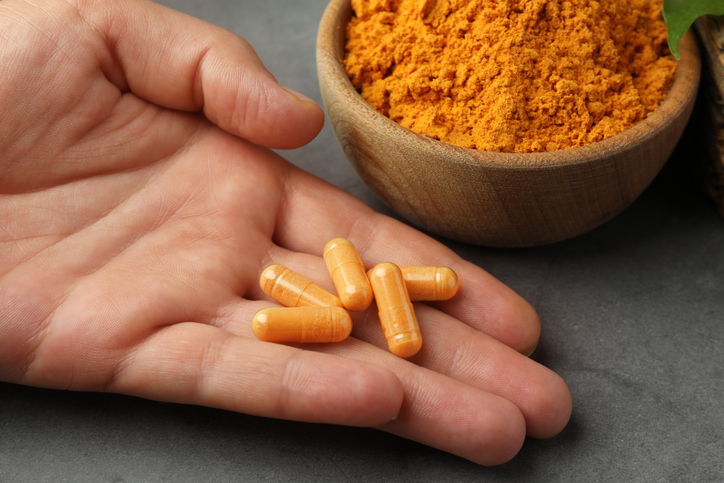
Turmeric, a spice commonly used in Indian cuisine, contains a powerful compound called curcumin. Curcumin is known for its anti-inflammatory and antioxidant properties, making it a potential ally in managing pain and reducing inflammation. It is also yellow-orange in color, hence the look of this tablet.
Osteoarthritis is an inflammation of your joints. Turmeric, paired with glucosamine, is marketed as a way to provide more comprehensive joint care, combining turmeric’s strong anti-inflammatory properties with glucosamine’s cartilage-repairing capabilities. Together, they offer a synergistic effect, reducing joint pain, swelling, and stiffness while simultaneously protecting and maintaining joint cartilage.
The anti-inflammatory properties do not just apply to your joints, either, and that’s a good thing. Systemic (or whole-body) inflammation is considered dangerous and believed to be the primary, underlying driver of cardiovascular disease, particularly atherosclerosis (plaque buildup in arteries), which leads to heart attacks and strokes. It is also a key factor in the development of other chronic conditions like type 2 diabetes, arthritis, cancer, and neurodegenerative diseases such as Alzheimer’s.
Turmeric has been studied over the past few decades to understand its potential health benefits. According to Harvard Health, one 2020 study found curcumin to be associated with anti-inflammatory, anticancer, antidiabetic, antidiarrheal, antimicrobial, antiviral, and antioxidant properties. Turmeric has been used for thousands of years in Ayurvedic medicine and traditional Chinese medicine to treat conditions such as skin disorders, respiratory problems, joint pain relief, and digestive disorders. Now, turmeric has become a popular dietary supplement promoted to benefit a variety of conditions including arthritis, digestive disorders, depression, and allergies, among others.
There are no official guidelines for how much turmeric you should take daily but in some trials two daily doses of 500mg were used, according to Healthspan. It is better absorbed with fats, so take yours with food. The directions on the bottle of my Osteo Bi-Flex say to, “Take two tablets per day preferably with food. Tablets can be taken all at once or throughout the day.” The units of turmeric are smaller than noted in research trials as two tablets contain 450mg of turmeric extract. Multiple sources noted that more research is needed to determine the optimal amount to consume to see benefits. As a result, the 450mg dose is acceptable to me for now.
Turmeric and curcumin supplements are classified as “generally recognized as safe” by the Food and Drug Administration (FDA), and both turmeric and curcumin appear to be safe and well tolerated, even when consumed in amounts up to 8 grams (about 3 teaspoons) a day. However, turmeric is likely to cause abdominal pain, nausea, and diarrhea when taken in high doses.
As is the case with all supplements, the FDA does not regulate the content of turmeric supplements. That means turmeric supplements may contain less or more than the amount on the label, and the contents may no longer be biologically active. Also, the supplement may contain other ingredients that could be harmful. For example, ground turmeric has been identified as a source of lead exposure in the U.S. (Harvard Health Publishing)
As with any supplement, let your doctor know if you are taking turmeric or curcumin. In addition, talk to your doctor before taking turmeric or curcumin if you have an underlying health condition or are taking medications, particularly if you are:
- taking blood thinners
- about to have surgery
- pregnant or lactating
- have gallbladder disease
- undergoing chemotherapy
In addition, people with diabetes should be aware that turmeric can lower blood sugar. (Harvard Health Publishing)
If supplements aren’t your thing, you can also add curcumin as a flavoring to a variety of foods and beverages. For example:
- coffee or tea
- golden milk (combine 1 to 2 teaspoons of turmeric with 1 cup of warm milk, black pepper, cinnamon, and honey or maple syrup over low heat for about 10 minutes.)
- soups and broths
- roasted vegetables
- rice dishes
- lentil or bean stews
The benefits of turmeric are getting renewed attention. According to Jane Collins, journalist, author, and editor specializing in women’s health in the UK, “The take-home message when it comes to optimizing your joint health is that turmeric is a perfect partner for glucosamine, as the two work synergistically with each other to create something of a nutritional powerhouse. Turmeric is a powerful anti-inflammatory. Glucosamine and chondroitin have a mild anti-inflammatory action but mostly act as biological signals to stimulate joint repair.”
Collins added, “The turmeric helps your body to maintain a normal healthy inflammatory response, and the glucosamine has mild pain-relieving effects and cartilage-protective qualities. Add the complementary joint-lubricating effects of chondroitin to this mix and you appear to have a marriage made in joint health heaven.”
Previously, I did not take a turmeric supplement before. But I will certainly give this a try in my Osteo Bi-Flex tablet. I like the joint benefits along with the whole-body benefit of decreased inflammation. As you look for ways to feel better and move better, consider turmeric as a potential tool in your toolbox.
Sources:
Systemic inflammation among adults with diagnosed and undiagnosed cardiometabolic conditions: a potential missed opportunity for cardiovascular disease prevention: Jan 11, 2024: https://pmc.ncbi.nlm.nih.gov/articles/PMC10808594/
The hidden link between inflammation and disease: Harvard T.H. Chan School of Public Health. https://www.youtube.com/watch?v=MlEIA9Vb02o&t=461s
Turmeric benefits: A look at the evidence, by Jenette Restivo: Harvard Health Publishing: https://www.health.harvard.edu/staying-healthy/turmeric-benefits-a-look-at-the-evidence#:~:text=Turmeric%20has%20been%20studied%20over,%2C%20antiviral%2C%20and%20antioxidant%20properties.
Leave a Reply