
By Nancy Alexander, PT, CSCS
April is Move More Month according to the American Heart Association (AHA). Nothing could align more perfectly with our mission here at the Living Well Academy. Whether you don’t move much at all, move some, or move a lot, there is always an opportunity for you to move more. Let’s review the how and why behind this. Every step you take counts.
Evidence-based guidelines can serve as a good starting point. The U.S. Department of Health and Human Services recommends that you get at least 150 minutes of moderate activity or 75 minutes of vigorous activity per week. You can also perform an equivalent combination of moderate- and vigorous-intensity aerobic activity over that time. You can also mix and match your activity to break things up. For example, you can get there by moving for 30 minutes, 5 times a week. Find the option that works best for you.
Here are some simple yet effective ways to move more from my book, Get UP! Defy Aging with Movement:
Make chores count. House and yard work can be quite a workout, especially when done at a brisk pace. Scrub, vacuum, sweep, dust, mow, and weed. They all count.
Look for ways to add extra steps. Take the stairs instead of the elevator or escalator. Park farther from a building entrance, rather than right out front. Get off your train or bus one stop early. The extra walking adds up.
Ditch the car whenever possible. Instead of driving everywhere, walk or bike when the distance is doable.
Move at work. Get up to talk to co-workers, rather than phoning or sending an email. Take a walk during your coffee and lunch breaks. Use the bathroom on another floor. Walk while you’re talking on the phone.
Working from home? No problem. Get up at timed intervals such as every 30 minutes or every hour. Set an alarm to remind you. Use an app on your phone that monitors this. Walk to the farthest point in your home and back. Repeat it if you can.
Get up during commercial breaks. Simply take a walk during breaks and every half hour. Sitting for a prolonged period of time compromises circulation and leads to joint stiffness.
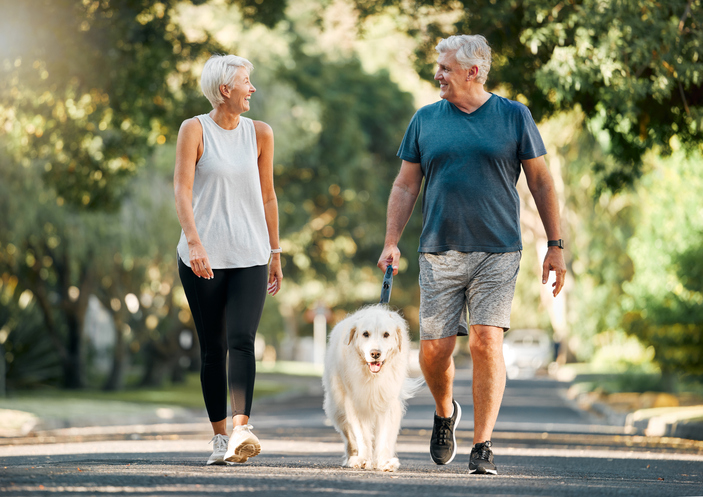
Owning a pet can often lead to a more active lifestyle. Playing with and taking a dog for a walk, hike, or run are fun and rewarding ways to fit movement into your schedule. Studies have shown that dog owners are far more likely to meet their daily exercise requirements than nonowners.
Look at your daily routine and consider ways to sneak in activity here and there. Even very small activities can add up over the course of a day.
Do you have fun gardening? Do it. It is movement and that counts. Join a fitness class in person or online. Try to incorporate strength training into your fitness routine as you age. And for your safety, engage in balance training and fall prevention activities on a regular basis.
Movement can add years to your life. And we’re not just talking about quantity, since these years tend to be high on quality, too. According to the Harvard Health Letter, “A study in the Nov. 6, 2012, PLoS Medicine finds that overweight or obese people who engage in leisure-time physical activity can extend their lives by as much as four years, compared with similar-weight people who do no such activity.” It adds that, “Being active and maintaining a healthy weight add an even bigger benefit, boosting longevity by more than seven years. (Harvard Health Letter, Exercise can add years to your life.)
The findings are similar to those of a study reported in the July 2012 Harvard Health Letter, which found that fitness and fatness independently affect your heart and have a greater impact when combined.” (Harvard Health Letter, Exercise benefits the heart.)
Move More Month is also accompanied with Walk More Month, according to the American Heart Association. They even sponsored a walk earlier this month to help promote the many health benefits of walking. Lengthening our lives is great but, as stated before, your quality of life improves, too. Research has shown that walking at a lively pace at least 150 minutes a week can help benefit you in the short term, too. You can:
- Think better, feel better and sleep better.
- Reduce your risk of serious diseases like heart disease, stroke, diabetes and several types of cancer.
- Boost your immunity.
- Improve your blood pressure, blood sugar and blood cholesterol levels.
- Increase your energy and stamina.
- Improve your mental and emotional well-being and reduce risk of depression.
- Improve memory and reduce your risk of dementia.
- Boost bone strength and reduce your risk of osteoporosis.
- Prevent weight gain.
(Heart.org/movemore)
Please know that short walks can add up over time. For some people, according to the AHA, that might look like a few 10-minute walks spread throughout the day. Begin with an amount of walking that feels right to you and build from there over time. You can vary it by starting at an easy pace and then walking faster if and when you’re ready. Gentle stretching afterward with 30-second static hold can feel good and help you reduce muscle soreness later.
Walking and movement are not only good for your overall health, they help you manage common conditions that come with aging. Osteoarthritis, for example, is very common as we get older and motion can help lubricate joints and provide nutrition to joint surfaces as you move. This helps you decrease stiffness and pain you often feel with arthritis. Motion is lotion.
Still unsure as how to move? Consider the following guidelines from my book, Get UP! Defy Aging with Movement:
What’s the right approach for you? Follow these steps to get moving and stay moving:
- Do what you enjoy. If you enjoy it, chances are you will stick with it, and that is what matters most.
- Do what is meaningful to you. Choose movement that it is consistent with your goals. Remember the law of specificity: If you want to walk better, walk. If you want to sit to stand better, make sure that’s part of your program. You can mix things up, but you must include what you want to improve. You wouldn’t play tennis to become a better swimmer, would you?
- Do what is safe for you. Maybe advanced dynamic balance exercises with a lot of movement are not appropriate for you right now. That’s okay. Try static (when standing motionless) ones instead. Start there and progress when safe to do so. Many modifications can be made with any good exercise program.
The key is to just start. Remember to always consult with your physician before you start any new exercise program. Second, consult with your movement professional such as a physical therapist who can skillfully evaluate you and then suggest appropriate exercises for you to do based on your goals.
The benefits of movement are immense in your daily life and your life further down the road. I propose that every month be move more month. Every step counts.
Sources:
American Heart Association. https://newsroom.heart.org/events/
Get UP! Defy Aging with Movement: Nancy Alexander, PT, CSCS
Harvard Health Letter: https://www.health.harvard.edu/newsletters/harvard_health_letter
U.S. Department of Health and Human Services, Physical Activity Guidelines for Americans
Leave a Reply